
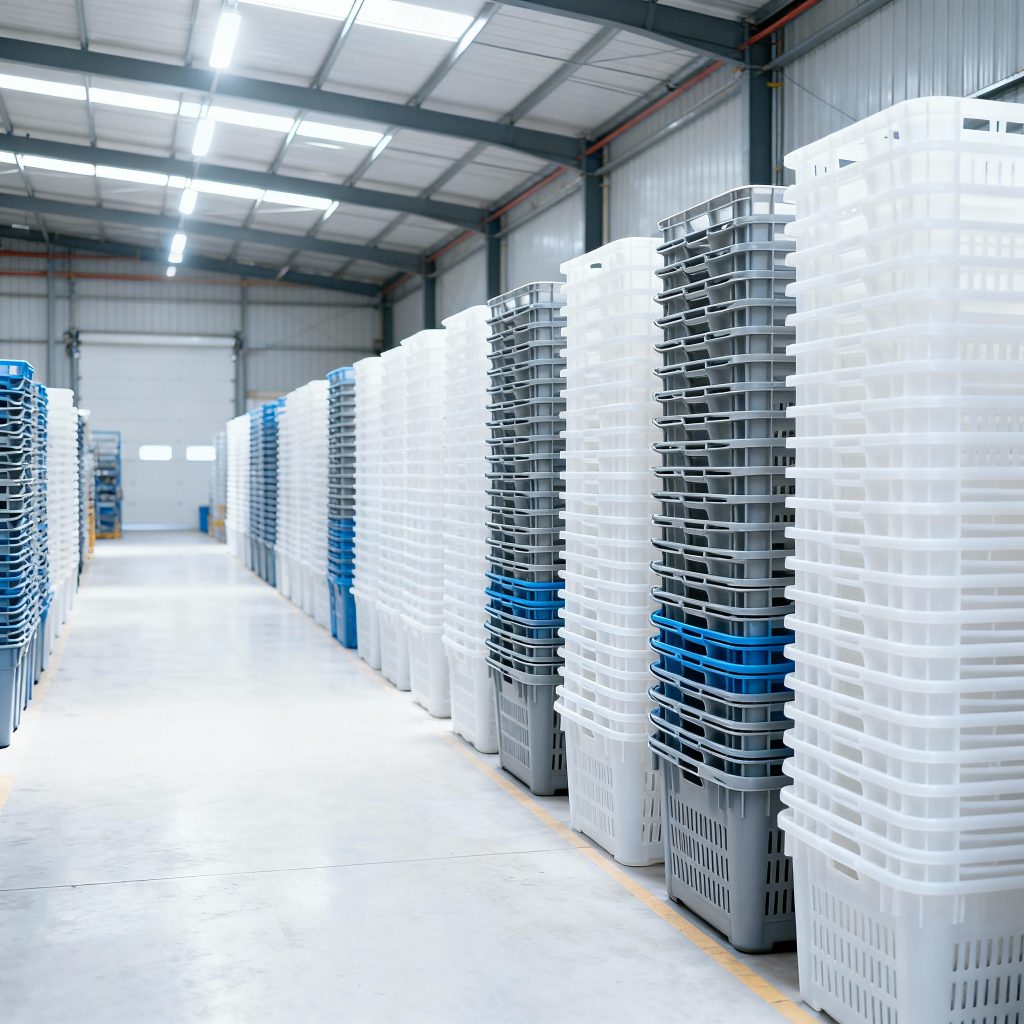
The production of plastic crates is entering a new era driven by innovation and intelligent technology as industries change. With a projected value of $5.9 billion in 2025, the global market for plastic crates is expected to reach nearly $8.9 billion by 2035, indicating a significant demand for more intelligent and environmentally friendly packaging options.
Market Growth and Industry Demand
The food and beverage, pharmaceutical, retail, and agricultural industries are the main drivers of this growth since they are all looking for dependable, reasonably priced, and sanitary materials for transportation and storage. Plastic crates are becoming indispensable in contemporary supply chains due to their strength, stackability, and resistance to moisture. This expansion is further supported by the trend toward returnable and reusable transit packaging, particularly in operations that are sensitive to temperature.
Smart Technology Integration
Plastic crates have been transformed by the use of smart technology, which turns them from simple containers into connected assets in the supply chain. Examples of innovations are:
- RFID Tags and IoT Sensors: These allow real-time tracking, inventory accuracy, and condition monitoring, such as temperature and humidity, which is critical for perishable goods.
- GPS tracking: Makes it possible to track a location in order to avoid misplacement and simplify logistics.
- Automated Sorting and Retrieval: Robotics and automation are combined with crates to lower labor costs and increase warehouse productivity.
- Mobile App Connectivity: For smooth supply chain management, remotely operate and keep an eye on crates.
Material Innovations and Design Enhancements
Manufacturers are utilizing modular, collapsible designs and advanced lightweight polymers to address environmental concerns and operational efficiency. These upgrades optimize warehouse storage space, cut down on transportation costs, and lessen carbon footprints.
Effect on the Efficiency of the Supply Chain
Plastic crates enhance supply chain performance by improving product protection, handling ease, and inventory visibility. Their hygienic properties make them ideal for delicate items, and their reusable nature encourages sustainability. Integrating smart technologies improves transparency and lowers errors, which helps businesses better forecast demand and manage resources.